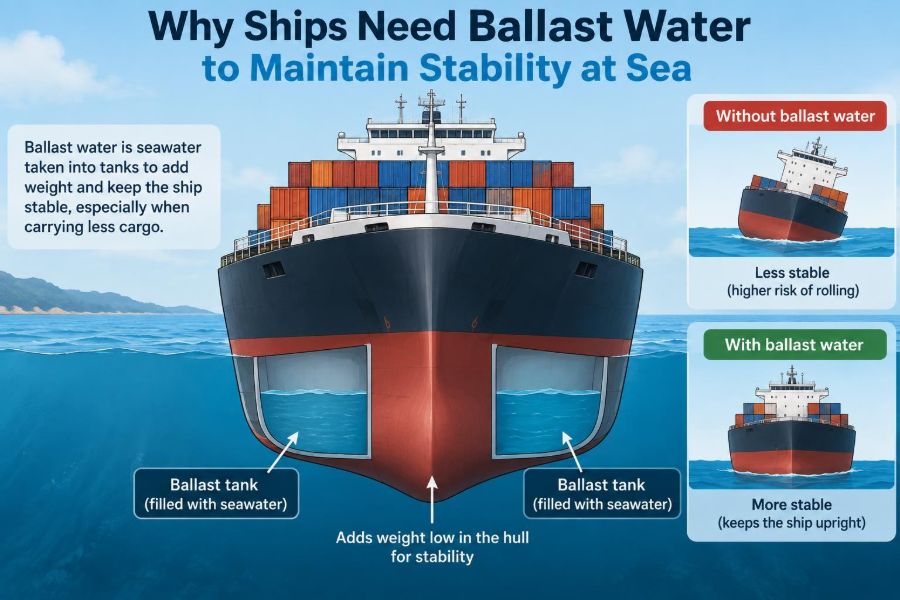

A cargo ship may leave port carrying containers stacked high above its deck, then return with far less cargo—or none at all. From shore, it can look as though the vessel simply has more empty space. From an engineering perspective, its entire balance, draft, and response to waves have changed.
Without corrective action, a lightly loaded ship can sit too high in the water, roll sharply, lose propeller immersion, and place unexpected loads on its structure. The solution is usually not visible from the quay: seawater is pumped into dedicated tanks low inside the hull.
That water is called ballast water. It is a practical tool for controlling a ship’s weight distribution, but it also creates environmental and operational responsibilities that modern crews must manage carefully.
Understanding ballast begins with a simple idea: a ship must float at a safe depth and remain upright, predictable, and structurally sound in the conditions it is expected to face.
⚓ What Ballast Water Is
Ballast water is water intentionally taken aboard and held in tanks to adjust a vessel’s weight, trim, draft, list, or stability. On most commercial vessels, it is seawater drawn through sea chests and pumped into purpose-built ballast tanks.
It is not the same as bilge water, which collects unintentionally in low spaces and may contain contaminants. Ballast is a planned part of ship operation, controlled through valves, pumps, level measurements, and a documented ballast plan.
🚢 Why an Empty Ship Behaves Differently
A ship’s displacement equals the weight of water it pushes aside. When cargo, fuel, stores, or passengers are removed, the ship weighs less and rises higher. Its underwater hull shape becomes smaller, and its centre of gravity may move relative to its centre of buoyancy.
A fully loaded bulk carrier and the same vessel in ballast condition therefore do not merely have different drafts. They can have materially different motions, propeller performance, visibility from the bridge, and structural loading limits.
🛟 Buoyancy: The Starting Principle
Buoyancy is the upward force created by displaced water. A floating ship settles until its weight is balanced by that buoyant force. Adding ballast increases the ship’s weight, so the hull sinks deeper and displaces more water until a new equilibrium is reached.
This does not mean “more weight is always safer.” Ballast must be placed where it produces the intended effect. Water in a low double-bottom tank affects the ship differently from the same water in a high wing tank.
📍 Centres That Control Stability
Naval architects describe stability through several reference points. The centre of gravity, usually called G, is the effective point through which the ship’s total weight acts downward. The centre of buoyancy, B, is the centre of the underwater displaced volume where buoyancy acts upward.
As a vessel heels, its submerged shape changes and B shifts toward the lower side. The resulting pair of forces can create a restoring moment that brings the vessel upright—or, if the geometry is unfavorable, can allow heel to increase.
📐 Metacentric Height and Initial Stability
For small angles of heel, engineers use the metacentre, M, to assess initial stability. The vertical distance between G and M is called metacentric height, or GM. A positive GM generally indicates an initial tendency to return upright after a small heel.
Ballast commonly lowers G and can increase GM. Yet a very large GM can make a ship “stiff,” with rapid, forceful rolling that is uncomfortable for people and hard on cargo, fittings, and structure. Safe stability is not simply maximum stiffness.
⬇️ Why Low Tanks Are So Effective
Weight placed low in the hull pulls the overall centre of gravity downward. Double-bottom tanks, located between the inner bottom and shell plating, are therefore especially valuable for ballast.
Think of a person carrying a heavy bag. Holding it near the floor is generally easier to control than balancing it above the shoulders. A ship follows the same broad principle, although its actual stability depends on hull geometry and loading calculations.
↔️ Correcting List
List is a persistent lean to port or starboard caused by unequal weight distribution, such as uneven cargo loading, fuel transfer, or damage. Crews may transfer ballast from one side to the other, or fill a suitable tank, to bring the vessel closer to upright.
Correcting the visible angle alone is not enough. The officer must understand why the list occurred. Moving water can mask a cargo problem while creating an unacceptable heel, stress condition, or stability margin elsewhere.
↕️ Managing Trim
Trim is the difference between draft forward and draft aft. A ship trimmed by the stern has a deeper aft draft; one trimmed by the head sits deeper forward. Fore-and-aft ballast tanks help the crew control this condition.
Appropriate trim can improve propeller immersion, rudder effectiveness, bridge visibility, and resistance through water. The best trim depends on vessel design, speed, loading condition, weather, and operational restrictions, so it is normally assessed with approved stability information rather than guesswork.
🌊 Keeping the Propeller and Rudder Effective
A lightly loaded vessel may rise enough for a propeller to operate too close to the surface. In rough seas, the propeller can emerge partly from the water, causing racing, vibration, reduced thrust, and possible machinery stress.
The rudder also needs a reliable flow of water, particularly during maneuvering. Ballast that gives adequate aft draft helps the propulsion and steering systems do their jobs when a ship is entering harbor, turning, or meeting head seas.
👀 Maintaining Safe Visibility
Ships need sufficient forward visibility from the navigation bridge. If a vessel trims excessively by the stern, its bow may rise into the officer’s line of sight; if it trims heavily by the head, the bow can bury more deeply and affect seakeeping.
Ballast is one tool used to keep the vessel within its approved visibility and operating limits. This is especially relevant for large ships whose bridge is far aft and high above the waterline.
🧱 Protecting Hull Structure
A ship is a long beam supported unevenly by the water beneath it. Cargo and ballast distributions create shear forces and bending moments along the hull girder. Excessive values can overstress structural members even when the vessel appears level.
For example, loading heavy cargo in separated holds while leaving intermediate spaces light can create a different longitudinal load pattern from a uniformly loaded ship. Ballast planning helps keep calculated structural forces within the ship’s approved limits.
🪨 The Difference Between Ballast and Cargo
Ballast has no commercial cargo value, but it provides controlled mass when paying cargo is unavailable or poorly distributed. Cargo is loaded to fulfill a transport contract; ballast is loaded to satisfy safe-operating needs.
Some cargoes can serve as useful low weight, but crews cannot treat cargo as freely movable ballast. Cargo stowage, segregation, securing, port sequence, and contractual requirements limit where and when it can be placed.
🏗️ Ballast Tanks Around the Hull
Tank arrangements differ by ship type, but common spaces include double-bottom tanks, wing tanks at the sides, forepeak and aftpeak tanks, and dedicated deep tanks. The arrangement gives operators options to manage transverse and longitudinal weight distribution.
| Tank location | Typical ballast purpose | Key consideration |
|---|---|---|
| Double bottom | Lower centre of gravity and add draft | Often efficient for stability |
| Wing tank | Correct list or distribute weight transversely | Free-surface effects require care |
| Forepeak | Adjust forward draft and trim | May affect slamming exposure |
| Aftpeak | Improve stern draft and propeller immersion | Must suit steering and trim limits |
🔧 The Ballast System on Board
A ballast system includes pumps, piping, valves, remote or local controls, sounding arrangements, vents, and tank level indications. It connects selected tanks to the sea and, on many ships, to a treatment system.
Valve line-ups matter. A wrong valve position can transfer water to an unintended tank, cause overflow, or leave a required tank unfilled. Clear procedures, communication between bridge and engine departments, and verification of tank levels are basic safeguards.
💧 The Free-Surface Effect
Partly filled tanks are a major stability concern. When a ship heels, loose water flows toward the lower side. Its centre of gravity shifts with it, reducing effective stability. This is called the free-surface effect.
A tank can contain substantial water and still provide less stability benefit than expected if it is slack, meaning neither pressed full nor empty. Wide tanks tend to create a larger free-surface correction than narrow tanks at a similar fill level.
⚠️ Why “Just Add Water” Is a Dangerous Idea
Ballasting is a calculation-based operation, not an intuitive response to a lean. Adding water to one tank can correct list while worsening trim, structural stresses, free-surface effect, or draft restrictions.
Every transfer changes the ship’s loading condition. Officers use approved stability data, loading computers where fitted, tank soundings, and operational procedures to check that the next stage remains safe—not merely the final appearance of the ship.
🧮 Stability Booklets and Loading Computers
Ships carry approved stability information that identifies permitted loading conditions and the assumptions behind them. Modern vessels often use loading instruments to calculate drafts, GM, bending moments, shear forces, and tank states as cargo and ballast change.
These tools support decisions; they do not replace sound inputs or professional judgment. Incorrect cargo weights, inaccurate tank levels, or misunderstood tank definitions can produce a reassuring screen display based on unreliable information.
📋 Ballast Water Management Planning
Ballast operations are normally planned before they begin. A workable plan identifies which tanks will be filled, emptied, or transferred; expected rates; stage-by-stage drafts; stability checks; structural limits; and any port constraints.
The plan should also consider simultaneous cargo operations, weather, pumping capacity, and contingency actions. Recording what was actually done is as important as drafting the original sequence, because the final condition must match verified tank contents.
🦠 The Environmental Problem
Ballast water can contain plankton, larvae, small invertebrates, bacteria, and sediment from the location where it was taken aboard. When untreated water is discharged in a distant ecosystem, some organisms may survive and establish themselves there.
This is why ballast water is more than a stability issue. It can become a pathway for aquatic invasive species and other biological transfers, with possible consequences for local ecosystems, fisheries, infrastructure, and coastal activities.
🌐 International Ballast Water Rules
International ballast water requirements are shaped principally by the International Maritime Organization’s Ballast Water Management Convention, alongside flag-state and port-state requirements. Ships subject to applicable rules must manage ballast water using an approved approach and maintain required records.
Requirements can depend on vessel type, trading pattern, certification, equipment status, and local rules. Crew should rely on the vessel’s current approved plan and verified regulatory guidance rather than assuming that one procedure applies in every port.
🧪 Ballast Water Treatment Systems
Many ships use a ballast water management system to treat water during uptake, discharge, or both. Common approaches combine physical separation, such as filtration, with disinfection methods such as ultraviolet treatment or approved chemical processes.
No technology is maintenance-free. Treatment effectiveness can be affected by flow rate, water turbidity, salinity, temperature, filter condition, power availability, and sensor performance. Systems must be operated within their approved limits.
🧫 Sediment Needs Attention Too
Sediment can accumulate in ballast tanks, particularly where water carries silt or organic material. It reduces useful tank capacity, can support organisms, complicates inspections, and may contribute to corrosion problems.
Tank cleaning and sediment handling require planned, safe procedures. Entering a ballast tank is a confined-space operation with serious atmospheric and rescue considerations; it is never simply a cleaning task.
🌦️ Weather Changes the Ballast Decision
Forecast conditions influence ballast choices. In heavy weather, operators may need adequate draft, propeller immersion, and stability while also avoiding an excessively stiff condition or harmful structural loading.
There is no universal “storm ballast” quantity. A condition suitable for one vessel can be inappropriate for another because hull form, tank layout, cargo, freeboard, speed, route, and approved operating guidance all differ.
🚢 Different Ship Types, Different Needs
Bulk carriers often make ballast voyages after discharging dense cargo, while tankers may ballast between cargo operations. Container ships must manage variable container weights and deck stowage. Offshore vessels may use ballast actively to control draft and working condition.
Passenger ships, vehicle carriers, dredgers, and naval vessels also use ballast in ways shaped by their design. The principle remains consistent: manage weight and buoyancy so the vessel has safe, predictable behavior for its intended operation.
⚖️ Stability Is Not the Same as Seaworthiness
A vessel can have positive initial stability and still be poorly prepared for a voyage. Seaworthiness also involves watertight integrity, cargo securing, machinery readiness, structural condition, weather routing, crew competence, and many other factors.
Likewise, a ship that looks upright may have hidden hazards: slack tanks, excessive bending moment, overloaded drafts, or unreliable level data. Ballast is one layer of safe ship operation, not a substitute for the rest.
🧯 Common Operational Mistakes
Many ballast incidents begin with routine errors rather than equipment failure. The recurring lesson is that changes in weight distribution need to be monitored as carefully as cargo loading.
- Relying on estimated, rather than verified, tank quantities.
- Leaving several broad tanks slack without accounting for free surface.
- Correcting list without checking the underlying cargo or flooding cause.
- Using a valve line-up that permits unintended transfer or overboard discharge.
- Ignoring draft, air-draft, or under-keel-clearance limits during ballasting.
- Operating treatment equipment outside its approved operating envelope.
🗣️ Communication During Ballast Operations
Safe ballasting depends on shared understanding. The responsible officer, engine room personnel, deck teams, terminal, and bridge watch may all need timely information about pump starts, transfer rates, tank changes, stoppages, and final soundings.
Closed-loop communication is useful: an instruction is repeated back, the action is completed, and the result is confirmed. This simple discipline reduces the chance that a verbal order becomes an assumption.
🔍 Inspections, Soundings, and Verification
Electronic level gauges are valuable, but independent checks remain important where procedures permit. Soundings, draft observations, pump pressure trends, and tank overflow monitoring can reveal discrepancies before they become serious.
Verification is especially valuable after switching tanks or changing pumping arrangements. A mismatch between expected and observed drafts may indicate incorrect tank data, a valve issue, an unplanned transfer, or inaccurate cargo assumptions.
🧠 A Simple Hypothetical Example
Imagine a cargo vessel that has discharged most of its cargo and is preparing for an ocean passage. Without ballast, it may have shallow aft draft, a high centre of gravity relative to its displacement, and rapid rolling.
The crew follows the approved loading plan, fills selected double-bottom and peak tanks, checks free-surface corrections, and confirms structural limits. The result is not merely a deeper-floating ship: it is a condition with calculated stability, usable propulsion, acceptable trim, and controlled hull loads.
📚 What Students Should Remember
Ballast water connects several core subjects in marine engineering and naval architecture: hydrostatics, ship stability, pumping systems, automation, corrosion, environmental compliance, and operational safety.
When analyzing any ballast decision, ask four questions: Where is the weight being added or removed? How will it change draft, trim, and list? What happens to stability and hull stresses? What environmental and procedural controls apply?
✅ The Core Principle of Ballast Water
Ships need ballast water because their loading condition constantly changes, while their need for stable, controllable, structurally safe behavior does not. By placing water in selected tanks, operators can adjust the relationship between weight, buoyancy, draft, and hull response.
Used well, ballast supports safe navigation, maneuvering, propulsion, cargo operations, and compliance. Used carelessly, it can introduce stability errors, structural risks, pollution concerns, and invasive-species transfer. The engineering value lies in deliberate control of both the water and the information used to manage it.
Ballast water is not simply extra weight: it is a carefully managed stability system that helps a ship remain safe, efficient, and predictable as its cargo and conditions change. ⚓🌊🚢