
Picture a container ship passing beneath a bridge, its deck stacked with steel boxes and its hull disappearing far below the waterline. It can look impossible: so much cargo, machinery, fuel, and steel supported by water.
The same question appears when a cruise ship leaves port with thousands of people aboard, or when a tanker carries a cargo measured in hundreds of thousands of tonnes. Ships are not floating because steel is magically light. A solid steel block sinks.
They float because naval architects shape, divide, load, and operate the vessel so that it displaces enough water while staying stable. That distinction is the foundation of ship design and safe operation.
Understanding it matters well beyond the classroom. It explains why a vessel has marks painted on its side, why cargo planners care about the location of every heavy item, and why a seemingly small amount of water inside a ship can become a serious concern.
⚓ The Short Answer: Buoyancy Supports the Ship
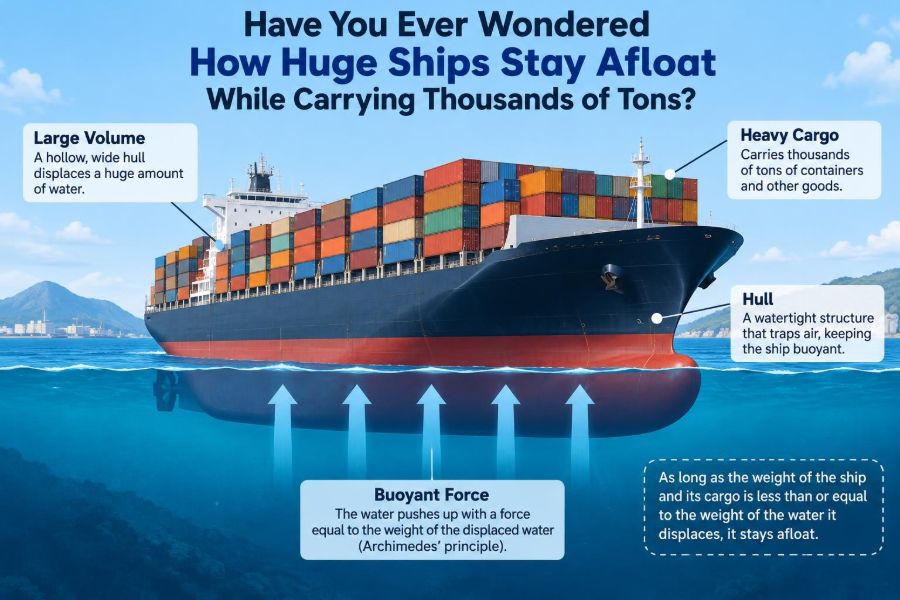
A ship stays afloat because water pushes upward on it. This upward force is called buoyancy, or buoyant force. It develops because water pressure is greater at deeper points than at shallower points.
For a floating ship in still water, the buoyant force equals the ship’s total weight. If cargo is added, the ship settles deeper, pushes aside more water, and gains buoyant force until a new balance is reached.
This is not a special property of ships. A person floating in a pool, a wooden raft, and a giant bulk carrier all follow the same physical principle. The difference is scale, hull form, and the care required to preserve stability.
🛁 Archimedes’ Principle in Plain Language
Archimedes’ principle states that an object in a fluid experiences an upward force equal to the weight of the fluid it displaces. For a ship, the displaced fluid is seawater or freshwater.
Imagine lowering an empty, watertight bowl into a tub. It sinks only until the water it has pushed aside weighs as much as the bowl. Put coins in the bowl and it goes lower; remove them and it rises. A ship behaves in the same way, although its hull is far more complex.
The key word is weight, not volume alone. A large hull has enough underwater volume to displace water weighing as much as the ship, its cargo, fuel, stores, crew, and passengers combined.
🧱 Why Steel Can Float
Steel has a greater density than water, so a compact block of steel will sink. A ship is not compact: its steel structure encloses a very large volume of air-filled, watertight space.
What matters is the vessel’s average density: total mass divided by the total volume enclosed down to the waterline. If that average density is lower than the density of the surrounding water, the vessel can float.
Think of an empty steel can and a crushed steel can. The crushed can has nearly the same steel mass but much less enclosed volume, so it displaces less water before becoming submerged. Hull shape is therefore central to flotation.
📏 Displacement Is the Ship’s Floating Weight
Displacement is the weight of water a vessel pushes aside. When the ship is floating freely, its displacement is equal to the ship’s own weight.
Marine engineers use displacement as a practical way to describe loading condition. A vessel at light condition, with little cargo and reduced consumables, has a lower displacement than the same vessel fully loaded.
The word is sometimes used for volume as well as weight, which can cause confusion. In design and operations, the units and context must be checked carefully. A volume of displaced water becomes a weight only after its density is considered.
🌊 Freshwater and Seawater Do Not Support Equally
Seawater is generally denser than freshwater because it contains dissolved salts. For the same submerged hull volume, seawater therefore provides more buoyant force.
A ship moving from sea to a river will usually sink slightly deeper in the freshwater. Moving from a river to sea allows it to rise slightly. The change may look small, but it matters when a vessel is loaded close to its permitted draft.
Water density also varies with temperature and salinity. Navigators and officers account for these differences when calculating allowable loading and when passing through areas with shallow water or restricted clearance.
📐 Draft Shows How Deep the Hull Sits
Draft, often called draught, is the vertical distance from the water surface to a defined point near the bottom of the hull, usually the keel. Draft marks on the ship’s side allow crews and inspectors to read it directly.
More weight means more draft. Draft limits matter because the ship must clear the seabed, channels, locks, berths, and underwater structures with an appropriate safety margin.
Draft can differ at the bow and stern. This difference, called trim, may be intentional within limits, but excessive trim can affect propulsion, steering, hull resistance, and visibility from the bridge.
🏷️ The Load Line Prevents Dangerous Overloading
The familiar circle and horizontal lines painted amidships are called the load line or Plimsoll mark. They indicate maximum permitted loading levels under defined water-density and seasonal conditions.
A ship cannot safely keep sinking deeper simply because it can still float. As freeboard becomes smaller, reserve buoyancy declines, deck openings are closer to waves, and the consequences of flooding or heavy weather become more severe.
Load-line requirements are part of a broader safety framework. The exact marks and permitted drafts depend on vessel characteristics and operating conditions, so crews use approved documentation rather than relying on visual judgment alone.
🚪 Freeboard Is More Than Empty Space
Freeboard is the vertical distance from the waterline to the deck edge or another specified reference point. It represents how much side of the hull remains above the water.
Greater freeboard generally gives more reserve before waves can reach deck-level openings. It can also improve tolerance to added weight, although it does not by itself guarantee good stability.
A low, heavily loaded vessel may still be compliant in calm water yet have less margin in rough seas. That is why loading decisions consider weather, route, vessel condition, and the integrity of all weather-tight and watertight closures.
🧭 Floating Is Not the Same as Staying Upright
Buoyancy explains why a ship does not sink under normal conditions. Stability explains whether it returns upright after wind, waves, a turn, or a shifting load causes it to heel.
A vessel can have sufficient buoyancy and still be unstable. If it heels and the geometry of the submerged hull produces a turning effect that increases the heel rather than correcting it, capsize can become possible.
This distinction is vital: naval architects design for both flotation and stability, while ship operators must preserve both through careful loading, ballasting, and damage control.
⚖️ Centre of Gravity Controls the Weight’s Lever
Every item on board contributes to the vessel’s centre of gravity, often abbreviated as G. It is the effective point through which the ship’s total weight acts downward.
Loading weight high up raises G. Loading it low down lowers G. A lower centre of gravity generally improves the vessel’s initial ability to resist heel, while a high centre of gravity can reduce that ability.
A practical example is a heavy engine spare. Securing it in a low storage space has a different stability effect from placing it on an upper deck. The cargo may weigh the same, but its vertical position changes the ship’s behavior.
📍 Centre of Buoyancy Moves When the Ship Heels
The centre of buoyancy, commonly called B, is the effective point through which the upward buoyant force acts. It is located at the centre of the underwater volume.
When a ship heels, the shape of the underwater volume changes. More hull may become submerged on one side while less remains submerged on the other, so B shifts toward the lower side.
This movement can create a restoring lever between the upward buoyant force and downward weight. It is one reason a properly designed ship tends to return toward upright after a small heel.
📈 Metacentric Height Measures Initial Stability
For small angles of heel, engineers use the relationship between G and a point called the metacentre, M. The vertical separation GM is known as metacentric height.
A positive GM is usually associated with positive initial stability: the ship develops a restoring tendency when slightly inclined. But “more GM” is not always simply better. An excessively stiff ship can roll quickly and sharply, increasing discomfort and stresses on cargo and structure.
Stability calculations also extend beyond small angles. The full righting-arm curve, known as a GZ curve, helps show how restoring ability changes as heel increases and where it may eventually be lost.
🌀 A Ship’s Roll Reveals Its Stability Character
A ship with high initial stability often has a short, rapid roll period. A ship with lower initial stability may roll more slowly and deeply. Neither observation alone proves a vessel is safe or unsafe.
Roll behavior depends on hull geometry, loading, liquid tanks, bilge keels, anti-roll devices, wave direction, speed, and other factors. Crews use the vessel’s approved stability information rather than making conclusions from motion alone.
Still, unusual rolling can be an operational clue. It may prompt officers to review ballast, tank levels, cargo condition, speed, and heading relative to the sea state.
📦 Cargo Placement Can Make or Break Stability
Cargo is not merely weight to be carried; it is weight that must be distributed. Container ships, general cargo ships, bulk carriers, and heavy-lift vessels all require planned stowage.
- Heavy units are generally placed lower where practical and permitted.
- Weight is controlled across port and starboard sides to avoid an unintended list.
- Longitudinal distribution is managed to keep trim and hull stresses within limits.
- Cargo must be secured so it cannot slide, topple, or shift in heavy weather.
A load plan must satisfy several limits at once. A ship can appear level while still having an unacceptable high centre of gravity or excessive structural loading in part of the hull.
🪨 Bulk Cargo Has a Shifting Hazard
Bulk cargoes such as grain, ore, or coal are carried loose in holds rather than inside individual boxes. Some cargoes can settle, flow, or shift when the ship rolls.
Grain is a classic example of a cargo that can move toward the low side after a heel, creating a heeling moment that may persist even when the original external force disappears. Specific loading arrangements and calculations are used to control that risk.
Moisture-sensitive bulk cargoes require another layer of care. Certain materials can behave more like a liquid when moisture conditions and vibration allow internal movement, so cargo declarations, testing, and loading procedures are safety-critical.
💧 The Free-Surface Effect Weakens Stability
Partly filled tanks are a major stability concern. When the ship heels, liquid in a slack tank flows toward the lower side. This movement effectively raises the vessel’s centre of gravity and reduces available stability.
This is called the free-surface effect. It can occur in fuel, ballast, freshwater, or other liquid tanks, and it is particularly significant when tanks are broad.
Operators minimize the effect by avoiding unnecessary slack tanks, following tank-management procedures, and including free-surface corrections in stability calculations. Filling a tank completely or emptying it completely often reduces liquid movement, but operational constraints and tank arrangements determine what is appropriate.
🎈 Reserve Buoyancy Provides a Safety Margin
Reserve buoyancy is the buoyant capability of the watertight volume above the present waterline. In simple terms, it is the flotation margin available before more of the hull becomes submerged.
High-sided ships often have substantial reserve buoyancy, but it is useful only if the spaces remain watertight. A flooded compartment no longer contributes its intended buoyant volume in the same way.
Reserve buoyancy supports survivability after limited damage, yet it is not a substitute for sound subdivision, reliable closures, and prompt action when flooding is suspected.
🧩 Watertight Subdivision Limits Flooding
Ships are divided internally by bulkheads and decks into compartments. A watertight bulkhead is designed to prevent water from passing between designated spaces when properly intact and closed.
If one compartment is breached, subdivision can confine flooding and preserve enough buoyancy and stability for the vessel to remain afloat. The outcome depends on the location and extent of damage, the ship’s loading condition, and whether water spreads to other spaces.
Watertight doors, penetrations for pipes and cables, ventilation closures, and access hatches all matter. A robust-looking bulkhead is only as effective as its openings and the discipline used to keep them correctly managed.
🚨 Flooding Changes Both Weight and Hull Shape
Floodwater creates two linked problems. It adds weight, making the ship sink deeper, and it may create a free surface that reduces stability.
Flooding on one side can cause list. Flooding low in the vessel may be especially influential because it changes local buoyancy and can reduce freeboard. Flooding higher spaces can be dangerous if it raises the centre of gravity or spreads rapidly.
Damage-control decisions can be complex. Counter-flooding might reduce a list in some situations, but it also adds weight and may reduce reserve buoyancy. It must be assessed through approved emergency procedures, not treated as an automatic response.
🔒 Watertight Integrity Is an Everyday Discipline
Watertight integrity means maintaining the barriers that keep sea and internal liquids out of spaces where they do not belong. It is built through routine actions, not only during emergencies.
- Inspect door seals, hatches, manholes, and ventilation closures.
- Keep drainage arrangements clear and understand where they lead.
- Close openings required by the vessel’s operating condition.
- Report corrosion, damaged gaskets, distorted covers, and unauthorized modifications.
- Verify closures after work that required access through a boundary.
Complacency is a common threat because a small defect may seem harmless in port. Heavy weather or an unexpected leak can expose that weakness quickly.
⚙️ Hull Form Balances Many Competing Needs
A hull is shaped for more than flotation. Designers balance cargo capacity, stability, resistance through water, seakeeping, structural strength, draft restrictions, maneuverability, and construction cost.
A wide hull generally offers more initial form stability and cargo volume, but it can create resistance or port-access constraints. A fine, narrow form may reduce resistance at some speeds but needs a different approach to stability and internal arrangement.
There is no universally best hull. A harbor tug, a fast ferry, a cruise ship, and a very large crude carrier face different operating demands, so their shapes reflect different compromises.
🏗️ Strength Keeps the Floating Hull Intact
Flotation assumes the hull remains structurally sound. A ship moving over waves experiences changing support along its length: one wave pattern may support the ends more than the middle, while another supports the middle more than the ends.
These conditions create global bending loads commonly described as hogging and sagging. Local loads from cargo, machinery, slamming, and tank pressures add further demands.
Loading manuals and computer systems help crews keep bending moments, shear forces, and local tank limits within approved ranges. A stable ship with improper structural loading is not a safely operated ship.
🧮 Loading Computers Turn Principles into Decisions
Modern vessels commonly use approved loading instruments to calculate draft, trim, stability, tank effects, longitudinal strength, and cargo distribution. These tools reduce calculation time but do not replace professional judgment.
Inputs must be correct: cargo weights, tank soundings, densities, and stowage positions all affect the result. A polished display cannot compensate for an incorrect cargo declaration or an unrecorded transfer between tanks.
Operators compare calculated conditions with approved stability booklets, loading manuals, and vessel-specific limits. Where rules, software, and observed conditions appear inconsistent, the discrepancy needs investigation before proceeding.
🛢️ Ballast Is a Powerful but Limited Tool
Ballast water is carried in dedicated tanks to adjust draft, trim, list, propeller immersion, and stability. An unloaded cargo ship may need ballast to sit safely in the water and achieve adequate steering and propulsion performance.
Ballasting changes the vessel’s weight distribution, so transfers are planned and monitored. Rapid or poorly sequenced transfers can create unacceptable stresses, list, free-surface effects, or operational confusion.
Ballast management also has environmental responsibilities. Water taken up in one region can contain organisms that should not be released untreated or unmanaged in another, which is why ships follow applicable ballast-water requirements and onboard procedures.
🌬️ Weather Can Challenge a Sound Design
Wind creates heel, waves create rolling and pitching, and following or quartering seas can produce difficult motion patterns. A ship that is safe in one loading condition may require different speed or course choices as weather worsens.
Parametric rolling, synchronous rolling, green water on deck, slamming, and broaching are examples of phenomena that depend on vessel type, hull form, speed, heading, and wave conditions. They should not be reduced to one simple rule.
Weather routing, conservative seamanship, secure cargo, correct tank management, and early course or speed adjustments give crews more options than waiting until motion becomes severe.
🛳️ Different Ships Float in Different Ways
All ships obey Archimedes’ principle, but their visible forms reflect their work. A containership needs deck and hold geometry for standardized boxes; a tanker needs segregated cargo tanks; a bulk carrier needs large holds; a passenger ship needs accommodation volume and evacuation arrangements.
| Vessel type | Typical flotation and stability focus |
|---|---|
| Container ship | High deck cargo, lashing, wind exposure, and container-weight distribution |
| Bulk carrier | Hold loading patterns, bulk-cargo behavior, and hull-girder strength |
| Tanker | Tank filling sequence, liquid free surface, segregation, and pollution prevention |
| Cruise ship | Passenger safety, high superstructure, subdivision, and damage stability |
| Offshore vessel | Variable deck loads, lifting operations, motion response, and specialized tank use |
The principle stays constant; the operational risks do not.
🪝 Lifting Operations Temporarily Change Stability
A heavy load suspended from a crane acts as though its weight has moved to the point of suspension. As the hook rises, the vessel’s effective centre of gravity can rise too.
If the load is swung outboard, it creates a heeling moment. Offshore supply vessels, crane ships, and ships handling heavy stores therefore use lift plans that consider load weight, radius, boom position, sea state, tank condition, and available stability.
The dangerous mistake is treating a lift as a simple deck operation. From a stability perspective, the whole vessel is part of the lifting system.
🧠 Common Misunderstandings About Floating Ships
One misconception is that ships float because air is “trapped underneath” them. Air enclosed inside a watertight hull contributes to low average density, but buoyancy comes from the water displaced by the submerged hull.
Another is that a wider ship is always safer. Width can improve initial stability, yet loading condition, free surface, hull form, windage, and behavior at larger heel angles also matter.
A third is that water inside a ship simply makes it heavier. It can also cause a list, reduce stability through free surface, and remove useful buoyant volume. Flooding is a geometric problem as well as a weight problem.
🧑🔧 What Marine Engineers Watch on Board
Marine engineers contribute directly to safe flotation by maintaining pumps, valves, tank-level systems, bilge arrangements, ballast systems, watertight doors where assigned, and machinery-space boundaries.
They also monitor leaks, tank levels, transfers, and changes in machinery-space condition. A small recurring bilge level is not merely housekeeping information; it can indicate a developing defect that affects safety or environmental protection.
Good communication between deck and engine departments is essential. Cargo, ballast, fuel transfer, and damage-control actions can affect both ship stability and machinery operation.
📝 A Practical Pre-Departure Check
Before sailing, a safe vessel condition is confirmed through ship-specific procedures. The details vary, but the thinking is consistent: know the weight, know where it is, know which spaces are secure, and know the limits.
- Verify cargo, fuel, ballast, freshwater, and stores against the intended departure condition.
- Check draft, trim, list, and relevant stability or strength results.
- Confirm cargo securing and closure of required hatches, doors, vents, and other openings.
- Review weather, route constraints, shallow-water limits, and expected operational changes.
- Ensure records and communication support a shared understanding across the crew.
This is not a substitute for statutory or company procedures. It is the operational logic behind them.
🎯 The Core Principle: Displace Water, Then Manage the Margins
Huge ships stay afloat because their submerged hulls displace water weighing exactly as much as the ships themselves. Their large, watertight volume makes that possible even though steel is dense.
But a seaworthy ship requires more than enough buoyancy. It needs acceptable draft and freeboard, sufficient stability, controlled liquid and cargo movement, structural strength, watertight integrity, and decisions suited to the voyage.
The elegant part of marine engineering is that these factors work together. A hull shape that carries cargo efficiently must still survive waves; a ballast plan that improves trim must not create poor stability; a compartment that contains machinery must also protect the vessel when damage occurs.
That is why a ship is not simply a giant floating container. It is a carefully managed balance of forces, volumes, weight distribution, and safety margins.
A ship floats by displacing its own weight in water, and it stays safe by protecting the buoyancy, stability, strength, and watertight margins that make that balance dependable. 🚢⚓🌊